Sam
Franks
Rhetorical
Protest Essay
February
21, 2016
Human
Rights Salute
“In the end, we
will remember not the words of our enemies, but the silence of our friends”
-
Martin Luther King Jr.
In the early
1960’s, the fundamental prize sought by the civil rights movement was something
that African Americans had never known: full legal equality. In the John F.
Kennedy Presidential Library and Museum’s e-newsletter, it was cited that in
America blacks “were denied the right to vote, barred from public facilities,
subjected to insults and violence, discriminated in housing, employment, and
education, and not expected to receive justice from the courts” (Civil Rights
Movement, Page 1).
Many colored
minorities, tired of being treated unlawfully, started to form protests, one of
which was captured by photographer John Dominis during the 1968 Mexico City
Olympics. John Dominis’ famous published photograph, displaying two African
American medal winners raising a black gloved fist in protest during the medal
ceremony, is a strong representation of equal human rights for African
Americans.
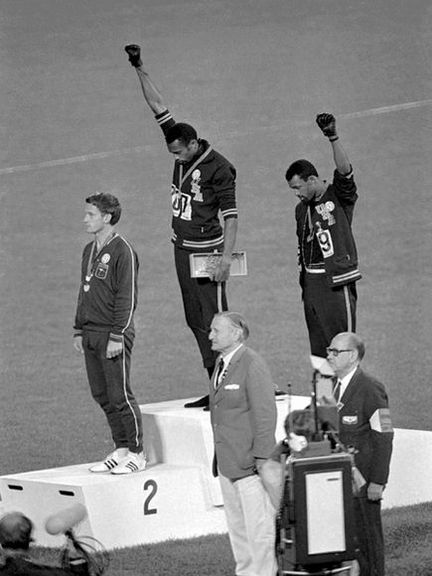
In Tommie Smith’s
autobiography, Silent Gesture, Smith
identified that the purpose of the gesture was not a “black power” salute, but
a “human rights salute” (Silent Gesture:
The Autobiography of Tommie Smith). John Dominis’ photograph, capturing
this iconic moment in sports history, outraged millions of fellow Americans
when it was published on the front pages of Life
and TIME Magazine a few days later (Paul
Vitello, Page 1). And while there was a sizeable amount of backlash from
individuals, countless millions more in America and around the globe were
thrilled by the sight of two men standing before the world, unafraid,
expressing their disillusionment with a nation that so often fell short of its
promises to minorities. Years later, in
an HBO documentary Fists of Freedom: The Story of the ’68 Summer Games, Smith
said, “we were just human beings who saw a need to bring attention to
inequality in our country. We were trying to tell African Americans to join
together and stand up against racism” (George Roy, 1999). This specific protest
during the games appeals to the African American audience and the black pride
identity during a tumultuous time in history when African American human rights
were being denied.
When I had first begun
probing the meanings behind John Dominis’ photograph, I recognized that the
published work appealed to two manners of persuasion: ethos and pathos. In the
photograph you can see that Smith and Carlos received their medals shoeless,
but were wearing black socks. This was an ethos rhetorical strategy aimed at
representing black poverty and the unequal income gap between blacks and whites
in America. Discover The Networks estimated
“the overall black poverty rate in the 1960’s was three and a half times higher
than the white poverty rate” The black socks were also considered a
representation of black identity and how human rights and fairness can be
achieved by fighting against racism. (Discoverthenetworks.org).
Slavery ended in 1865, but African Americans were still being treated like
second-class citizens. “They were discriminated from public services, and
schools that were “colored” were given poor funding. Blacks were not permitted
to use white restaurants, and while city money was spent making white
facilities better, the “colored” ones were allowed to fall to shambles. It was
separate and unequal” (Discoverthenetworks.org).
This inequality, although socially acceptable at the time, was in fact immoral
and unethical. This abysmal image was shocking to the rest of the world
watching the Olympics, as it shed light on the moral issue and problem of black
maltreatment in America.
Although there was
a strong component of ethos in the photo, pathos was also a large leitmotif in
the published image. In the top portion of the photo, you notice Smith and
Carlos each with a single black-gloved fist raised above their head, which was
intended to signify African American pride and the black power identity. By
standing together side by side, holding a fist in the air, they sent a message
to all African Americans that protesting together and fighting for equal rights
is a noble and worthwhile cause. Taking his own stand against American racism
was Peter Norman, the silver medalist on the podium with Smith and Carlos. Ben
Cosgrove, a journalist from TIME Magazine, wrote “Australian silver
medalist Peter Norman stood solidly with Smith and Carlos, both literally and
figuratively—displaying his solidarity with their action by wearing an Olympic
Project for Human Rights badge during the medal ceremony” (Cosgrove, Page 1).
Peter Norman confirmed in a later interview that when Smith and Carlos asked
him to help, he simply stated, “I’ll stand with you” (Cosgrove, Page 2). The picture
of all three athletes standing in unity with one another in a show of support
for African American rights and equality was an image that evoked much emotion
from viewers of John Dominis’ photograph.
The 1968 Mexico
City Olympics was one that will be remembered as a turning point in the Civil
Rights Movement. Tommie Smith and John Carlos, with the support of Peter
Norman, decided to stand together in unanimity and protest racial inequality while also taking pride in being African
Americans. The emotional image made America and the world consider the ethical
issues behind the treatment of "colored people" in society. The identity of “black power”
spoke to many African Americans during the 1960’s era and ultimately led to a more
positive societal and cultural change within the USA. We still have a long way
to go in terms of erasing racism for good, but thanks to John Dominis’ timely
photograph, we are one step closer.
"Civil Rights
Movement." - John F. Kennedy Presidential Library & Museum. N.p., n.d.
Web. 23 Feb. 2016.
<http://www.jfklibrary.org/JFK/JFK-in-History/Civil-Rights-Movement.aspx>.
Cosgrove, Ben.
"The Black Power Salute That Rocked the 1968 Olympics." Time. Time,
n.d. Web. 23 Feb. 2016.
<http://time.com/3880999/black-power-salute-tommie-smith-and-john-carlos-at-the-1968-olympics/>.
"John
Dominis: Celebrating the Work of a Master Photographer." Time. Time, n.d.
Web. 23 Feb. 2016. <http://time.com/3524708/photographer-spotlight-john-dominis/>.
"Repertuar
Kin." Fists of Freedom: The Story of the '68 Summer Games (1999). N.p.,
n.d. Web. 23 Feb. 2016.
<http://www.filmweb.pl/film/Fists+of+Freedom%3A+The+Story+of+the+%2768+Summer+Games-1999-148264/showtimes/Warszawa>.
Smith, Tommie, and
David Steele. Silent Gesture: The Autobiography of Tommie Smith. Philadelphia,
PA: Temple UP, 2008. Print.
Vitello, Paul.
"John Dominis, a Star Photographer for Life Magazine, Dies at 92."
The New York Times. The New York Times, 31 Dec. 2013. Web. 23 Feb. 2016.
<http://www.nytimes.com/2014/01/01/arts/design/john-dominis-a-star-life-magazine-photographer-dies.html?_r=0>.

This article really caught my attention from the first quote. I also liked how you were able to identify the ethos and pathos in your article. Especially with the image of black power in the picture. I would change having two quotes back to back starting off the article. As well as maybe changing the first quote to a quote of one of the olympians. For me the quote didn't quite go with the picture. Also I believe you have too many quotes in the article and a reader could get lost in trying to distinguish between what your trying to address and the actual quotes themselves.
ReplyDeleteI thought that the object you chose to write about was a very good choice! It was clearly part of a protest, and within that protest is a clear identity. I think you described the context, 1968 Olympics, very well and you laid out the purpose, tackling racism, within your paper. With that being said, I do not feel as though I walked away knowing who the specific target audience was. Your quotes talk about the reaction to the action "in American and around the globe" so I am guessing the audience was everybody, and not just those at the Olympics. I think it would be nice to come out and say that, rather than imply it.
ReplyDeleteIn terms of the structure of the paper, I somewhat agree with Harold about the quotes. While I also feel it is hard to distinguish between the argument and quotes, I have a different take on them. For me, it was kind of distracting as a lot of the words weren't necessarily yours. Also, I was a little curious as to what the thesis was for the essay, though I'm guessing it was the first sentence.
I thought the paper did a pretty good job overall. You identified an object, and you also identified the problem the object was addressing. I also liked the majority of your structuring, as you clearly identified the pathos and ethos. In terms of revision, I would say 1.) clearly identify the audience that is being addressed and 2.)maybe cut down some of the quotes, but to me the main issue was the first comment.
So theres quite a few things that I need to fix before I turn in my final draft:
ReplyDeleteFirst off, I need to get rid of the opening quote. It was originally supposed to fit with my paper, but as I finished writing it I realized it didn't fit. I have a better quote from TIME Magazine that I think I want to use.
I also need to fix my citations and small things like that, I didn't correctly cite things. I felt as well that I didn't clearly explain the specific identity and the intended audience, so I want to go back and find places within my paper that I can write that in so that it becomes clear to the reader. Along with that I need to put more evidence into some of my paragraphs, I think there was only two small places where more evidence is needed so thats not too much of a big deal.
I don't think that I outlined it clearly what my protest was in terms of the actual physical salute or the photograph my John Dominis. I think my paper leans more towards the salute and the photo was an important, but not main aspect of my rhetorical analysis.
I think I did some things well, but I know I have some significant changes to make!